Welcome to the Lawson Unit Newsletter
We are delighted to share this edition of our Lawson Unit newsletter which has once again been created entirely by members of the Lawson Unit Patient Panel. Written by patients, for patients, it reflects the voices, experiences, and insights of our own community. As a department, we’re incredibly proud to see our patients leading the way in shaping this and future editions of our bi-annual newsletter — a true collaboration that celebrates shared learning, creativity, and lived experience.
Editors: David and Nigel
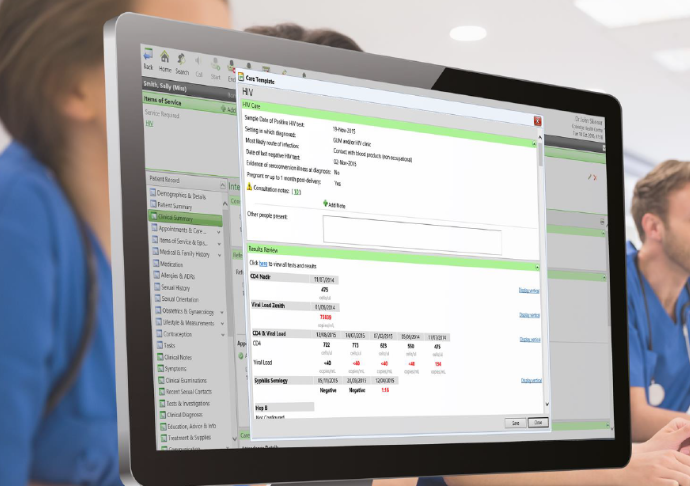
“Inform“” – The New Patient Record System for HIV and Sexual Health

What is Inform?
Inform is the new software system we use to safely store and manage health information at the Lawson Unit and Sexual Health & Contraception (SHAC) services. It keeps everything in one secure place, including:
- HIV and sexual health notes
- Blood test results
- Medical history
- Copies of relevant clinic letters
- Details of past and future appointments
- Prescriptions
What does Inform include?
- Electronic Patient Record (EPR): The information in the EPR is what is used to manage a patient’s care. It is linked to our hospital lab system so that test results are automatically added and it also links to the EmERGE app so that this digital care pathway continues as normal.
- Personal Health Record (PHR): This is a new online portal which you can use to book sexual health appointments, order postal test kits, share images or documents when needed, and view some of your results.
What does this mean for a patient of the Lawson Unit?
Most things stay the same:
- Your care and treatment
- How you book appointments
- How you contact us
- The EmERGE pathway
During the move to our new system, appointment availability may be slightly reduced and some appointments may take a little longer than usual. This will only be temporary while the team works hard to make the transition as smooth as possible. You may also receive an extra text message confirming an appointment you have already booked — this is an automatic part of transferring appointments from one system to another.
So, what’s new?
Some patient’s clinic numbers will change:
- Patients with an M or F number will be given a new B number.
This will include the numbers from their current Clinic ID, plus one extra digit. - Patients with a B number will keep the same Clinic ID with no changes.
All patients will have a choice about how their Lawson Unit tests are ordered. You can:
- Choose to use your Hospital ID (which we would recommend)
- Or continue to use an anonymous Clinic ID
Why choose Hospital ID?
- Your hospital ID means that medicines can be prescribed more safely because details of previous treatments are available
- A full and complete history of your results will be available through your Hospital ID
- It links all inpatient, outpatient and GP results into one record making it easier to share information with teams involved in your care. It’s safer for all medical teams involved to know about abnormal results and may help to reduce the number of blood tests you need.
- This is a national initiative across services for people living with HIV.
How do other NHS teams see results?
If your tests are under your Hospital ID, and your NHS number is on your record, results can be shared through NHS systems. This will help if you receive care outside Brighton & Hove and support the care provided by your GP. Other clinicians involved in your care may be able to work out that you have been diagnosed with HIV from these results or letters. All health care professionals and providers are bound by confidentiality. While we recommend using your Hospital ID for safety reasons, if you prefer your results to stay confidential within the Lawson Unit, you can choose to keep using your anonymous Clinic ID.
As a patient, it is your decision as to whether tests are requested under your anonymous Clinic ID or Hospital ID. We will talk it through with you at your next appointment, answer any questions, and you will be able to change your choice at any time in the future.
If you choose Hospital ID:
- Lawson Unit tests will be under your Hospital ID
- Sexual health tests undertaken at the Lawson Unit or within the Sexual Health Service (including postal kits) will stay under your anonymous Clinic ID
- Your Lawson Unit results will be visible to your GP, hospital clinicians, and other NHS Trusts
- Results will also appear in your NHS App
- If you agree for us to contact your GP, a copy of these letters will be saved in your hospital record
Over the last 2 years we have been dedicated to ensuring a smooth transition from one system to another and making sure we keep patients at the centre of everything we do. We have worked with the Lawson Unit Patient Panel group to co-produce this patient-focussed video which aims to look at the switch to using Hospital IDs from a patient’s perspective:
A special THANK YOU to everyone involved in the creation of this video, including Jo & John, the Lawson Unit Patient Panel, Dr Sonia Raffe, and Katie and James from the hospital clinical media team.
Important information if you get your Lawson Unit prescriptions from Pharm@Sea

This does not affect anyone who currently receives their medicines by Alcura delivery
There have been a few changes in Pharm@Sea recently. They are taking on more out-patient work from other hospital departments so are expecting their workload (and therefore waiting times and number of people waiting in the pharmacy) to increase in the coming weeks.
They are very keen that this doesn’t impact on prescriptions from The Lawson Unit and are offering the following options:
- Free delivery of medication to home: this usually takes 1-2 weeks.Contact the Lawson Unit pharmacy team if you are interested
- ‘Non-urgent’ prescriptions (i.e. not needed within a week) are dispensed off-site and the medicines then securely transferred back to Pharm@Sea for collection as normal
- Prescriptions needed within a week will be dispensed in Pharm@Sea as normal and can be collected a day or two later
Prescriptions needed the same day can still be taken to Pharm@Sea and waited for as usual (but be aware of the possibility of a longer wait)
If you opt for options 2 or 3 you will now be contacted by Pharm@sea (by phone call or text) to let you know when your medication is ready for collection. This should mean no waiting when you come back to collect (be sure to have your clinic number to hand). Prescriptions must be collected within 3 weeks of notification.
Please don’t forget to tell your HIV doctor, nurse or the Lawson Unit pharmacy team when you need your medication so we can help Pharm@Sea ensure it is ready when you need it.
For more information contact the Lawson unit pharmacy team – 01273 664948
HIV and Ageing
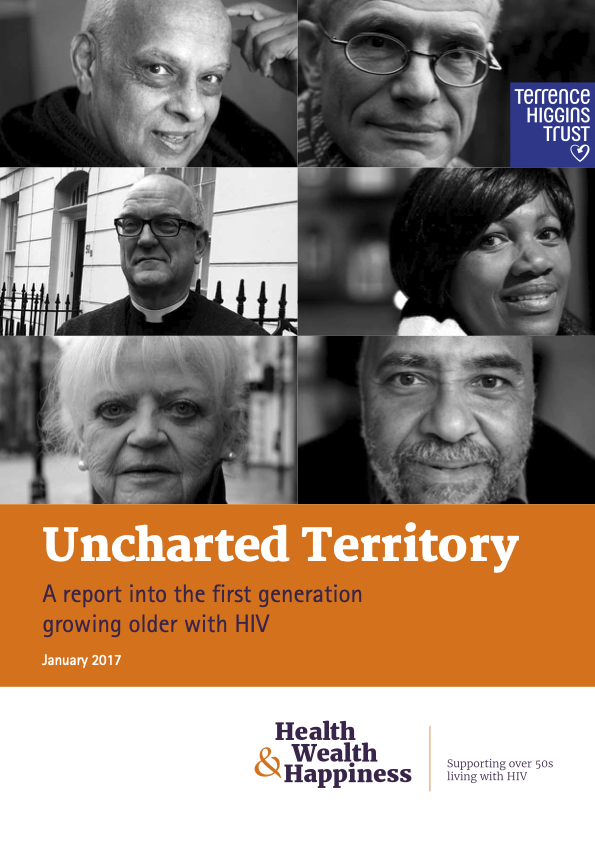
(This article is reproduced by kind permission of the Terrence Higgins Trust)
Many older people who are living with HIV lead healthy, active, and exciting lives, but some health problems can be more common in people living with HIV.
Does HIV make me age faster?
People with HIV are now living longer than ever because of effective HIV treatment. Some research has suggested that HIV causes the immune system to age faster than it should, meaning that younger people with HIV can have ‘older’ immune systems. This is because the virus causes the immune system to become inflamed and also due to the effects it has on some of the CD4 cells. However, it is not certain that HIV can speed up the ageing process and is likely to vary greatly between individuals.
There is some evidence that younger people with lifelong HIV have a greater risk of some ‘age-related’ health problems such as cancers, cardiovascular disease, and osteoporosis. Additionally, there has been an increase in the number of older people living with HIV experiencing age-related diseases. Age-related illnesses, particularly heart and kidney, are more common in older people living with HIV.
Some studies suggest that living with HIV might make it more likely that women and other people with ovaries going through the menopause will experience menopausal symptoms:
What is happening to my body as I get older?
Over time, our bodies gradually lose strength, although we now know the benefits of a healthy lifestyle and exercising as we age. This means that older people now lead healthier, longer lives than in previous generations.
As people age, their immune systems make less of the specific T-cells needed to respond to new infections and to develop immunity after a vaccination. This is why it can generally be harder for older people to recover from illnesses and why they may not develop protection after an immunisation.
Improving your general health
Although no one can stop the ageing process, lifestyle changes can be made which will help keep bodies stronger and healthier into old age. These include stopping smoking, exercising more and eating well, as well as managing HIV well. Living with HIV can be an added complication when ageing, but improving general health can prepare bodies for a happy, healthy older age.
Ideas needed!! Help us make the Lawson Unit a more sustainable service
As some of you already know, the Lawson Unit has a patient representative on the ‘HIV/SHAC Green Team’, a multidisciplinary group formed in 2022. The team meets monthly online, and consists of nurses, doctors, pharmacists, health advisors, and admin reps to make suggestions which might improve the sustainability of the services.
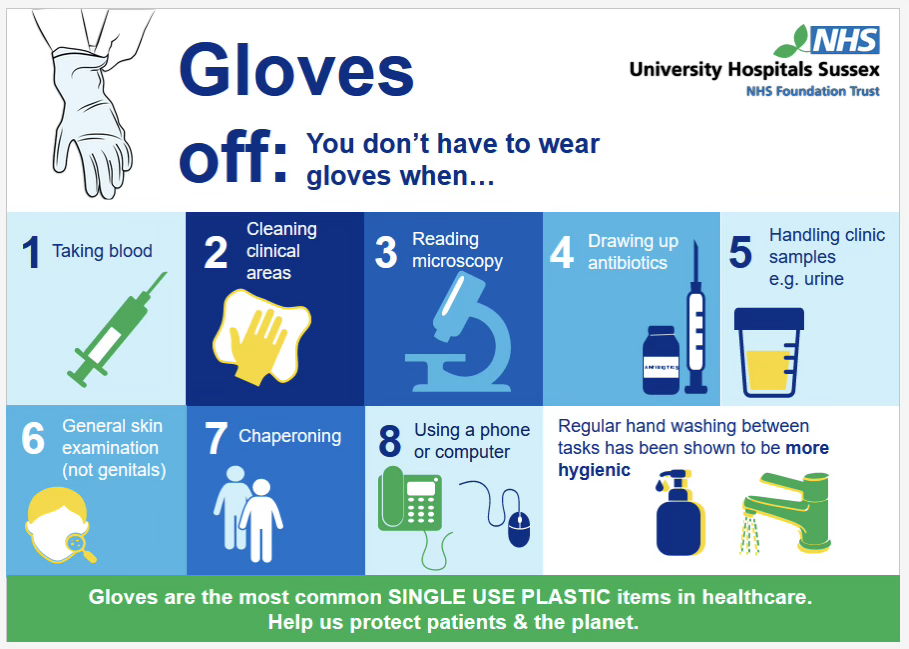
To date, the group has been nationally recognised within the NHS, and many of the suggestions have been implemented. these include reducing single-use plastics, the ‘Gloves off campaign which aims ’ to reduce the use of disposable gloves (see below), reducing the use of disposable speculums, and eliminating where possible any printing on paper.
As a patient of the Lawson Unit, you might also have ideas, no matter how small, which could contribute to reducing waste and making the Lawson Unit even more sustainable. Please let us know, and these will be fed back to the group.
Click here to submit any ideas you may have
Recycling blister packs and saving money
Living with HIV, we are not strangers to taking medication, not just our antiretrovirals, but often for other health reasons. All medicines have to be stored and packaged properly, but that does leave us with having to consider what to do with our waste packaging.
What can we do as patients to help reduce waste and maximise the use of recyclable materials?
Many of the plastic bottles that our medicine comes in are easily recycled in household waste, but what are we supposed to do with our blister packs? High street chemists like Superdrug and Boots do allow us to give them our old blister packaging for recycling.
With the cost of living very much in people’s minds, Boots (the chemist) offers 100 points (worth £1), added to their loyalty card scheme for every five blister packs that are recycled.
To get the benefits of the Boots scheme, you have to manage your recycling in an app. Search Google Play or Apple App Store for the “Recycle at Boots” app. You log your blister packs in the app and after a 24-hour wait for validation, you pop along to larger stores and place the packs in the recycling bins. You are then awarded £1 worth of points that you can spend.
If you know of any other schemes please let us know and we can feed back to the Green Team.
United Kingdom Community Advisory Board (UK-CAB)
The UK-CAB is a community organisation made up of people living with HIV.
If you like to keep up to date with all the latest HIV treatments, clinical trial information, and to speak to other HIV advocates, then this network is for you.
As the name suggests, this board of people living with HIV works closely with industry such as drug companies and medical professionals. Our lived experience is a very important resource to ensure that both medical professionals and drug companies understand what it is like to live with HIV.
The network aims to develop strength and support HIV treatment advocacy in the UK, provides expert training on current treatment issues, provides opportunities to meet doctors, researchers, and pharmaceutical companies. The network also provides community representation in the design and management of clinical trials and in setting standards of care.
The UK-CAB connects over 550 members from over 120 organisations.
How the UK-CAB network works
The UK-CAB connects members via a web-based message board and a programme of meetings.
The message board enables members to contribute and comment on treatment guidelines, clinical trial design, and to generally communicate with other advocates and to keep up to date with reports on the latest research.
The UK-CAB provides training to enable full involvement in UK-CAB meetings, and to provide a valuable bone of knowledge of HIV treatment and treatment-related issues for healthcare workers.
How to join for free
The UK-CAB is free to join and all you need is to have lived experience of living with HIV and have an active email address. It is also possible to join the UK-CAB if you are a HIV community advocate or working in health or social care roles for people living with HIV, careers for people living with HIV, and parents of guardians of children under 16 living with HIV. Individuals join the UK-CAB as members in their own right.
(Regrettably, due to potential conflict of interest, it is not possible for people who work for drug companies involved in HIV research or PR, marketing, or other professional companies whose clients include HIV drug companies, to join. This is to ensure that the UK-CAB is a community-based organisation and is not influenced by any lobbying.)
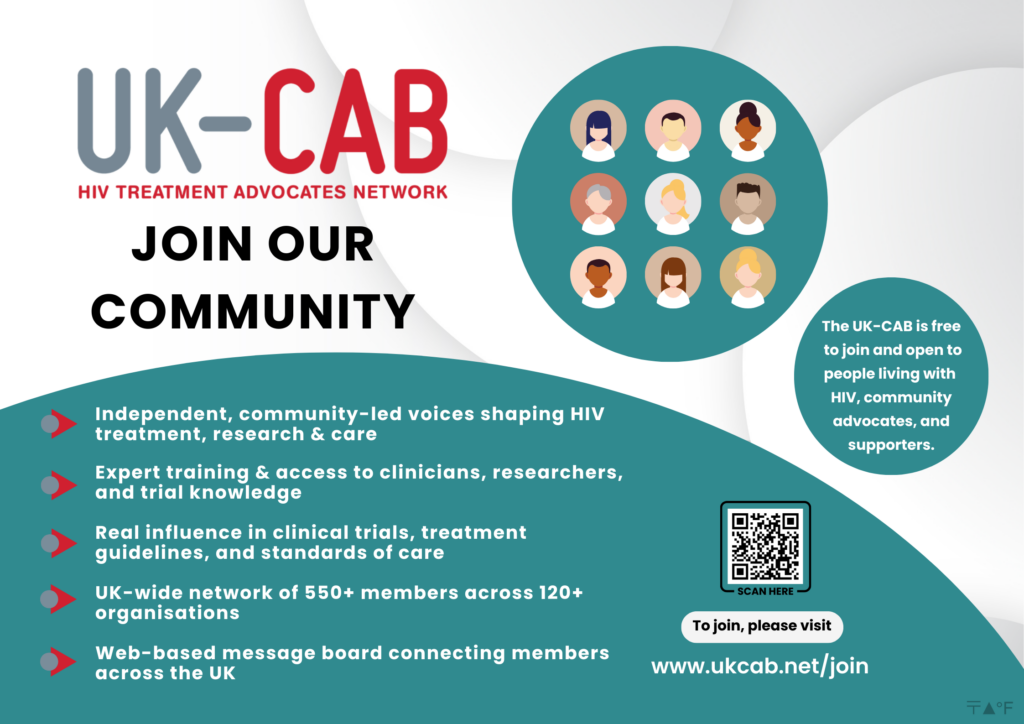
To join for free, please visit the UK-CAB website Click here for more info
(Please note a valid email account is needed for membership)
National HIV Action Plan for England 2025-2030
Did you know that the government recently announced a £170 million investment to help fund five priorities in HIV care, prevention, and treatment?
- Prevent – equitable access to HIV prevention
- Testing – scaling up HIV testing
- Treat – rapid linkage and retention in HIV care
- Thrive – addressing stigma and improving quality of life for people living with HIV
- Collaborate – strengthen and partner across the sexual and reproductive health and wider system
It is interesting to note that this is the first five-year HIV plan that takes into account the specific needs of women living with HIV.
“Our task is now clear: to turn decades of progress into lasting change, and end HIV transmission, with a bright future for those living with HIV.” Wes Streeting, Secretary of State for Health and Social Care.
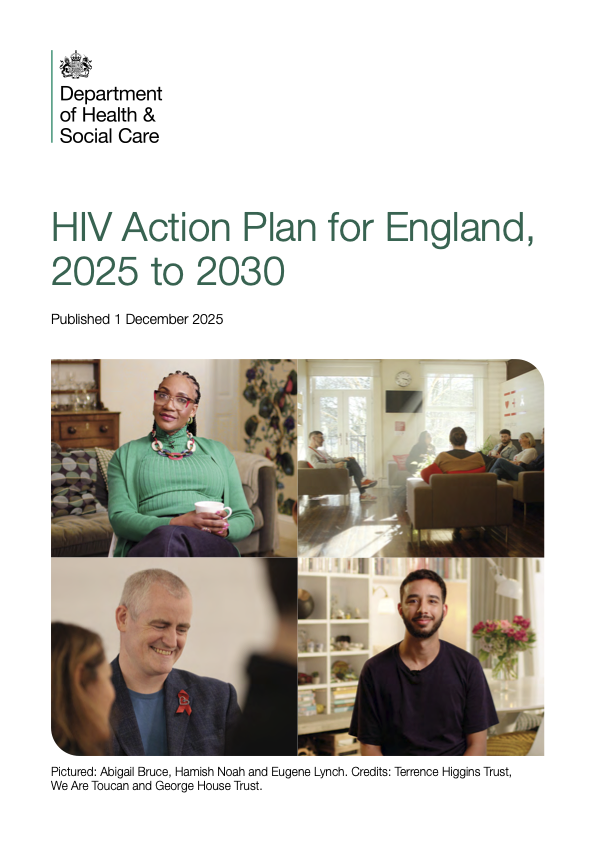
If you are interested in the next five-year plan, the document can be found at the following link or clicking on the image below: Click here for HIV 5 year action plan