
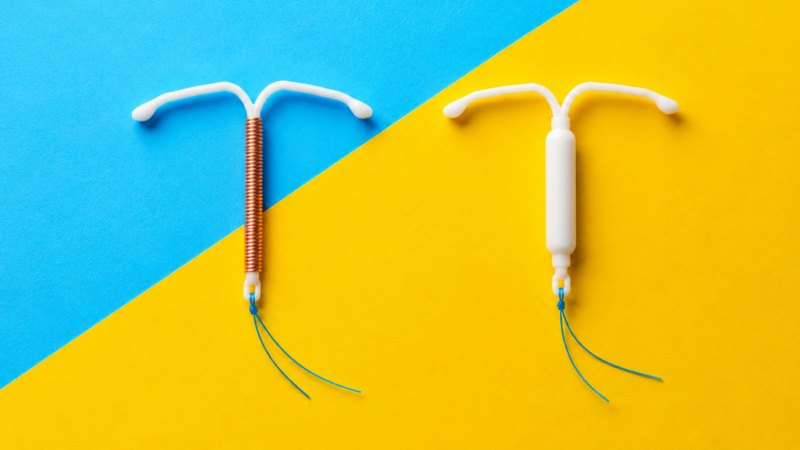
What is intrauterine contraception?
Intrauterine contraception is a type of long acting contraception where a small device is inserted into the uterus to prevent pregnancy.
We offer different types of intrauterine device at SHAC:
Levonorgestrel intrauterine device (LNG-IUD or ‘hormonal coil’)
It releases a small amount of hormone into the womb, which thins the lining of the uterus to prevent a fertilised egg implanting and thickens the cervical mucus which makes it difficult for sperm to reach an egg. Depending on the type it can last for 3-8 years. The hormonal device can also help relieve symptoms of heavy menstrual bleeding and period pain, as it can thin the womb lining.
For the first few months after fitting, some people experience hormonal side effects (Mood changes, breast tenderness, acne) and a change to their bleeding pattern (usually lighter and less frequent bleeding). These side effects usually settle within a few months, but if you have any concerns, we are happy to talk to you about any side effects you are experiencing.
Hormonal devices commonly used in the UK & how long they can be used for contraception if you are under age 45:
- Mirena – 8 years
- Levosert – 8 years
- Benilexa – 8 years
- Kyleena – 5 years
- Jaydess – 3 years
If you are 45 years or older and have any 52mg levonorgestrel hormonal device (Mirena, Levosert and Benilexa) inserted for contraception then this can be used up until age 55 when contraception is no longer required.
We are unable to offer a new 52mg levonorgestrel hormonal device fit or a change of device at 5 years for HRT only, please contact your GP for an appointment. Alternatively, if your GP does not offer this service, you can refer yourself for an appointment with the Brighton and Hove Federation.
Copper intrauterine device (Cu- IUD or ‘copper coil’)
There is a copper thread woven around the T-shaped device. Copper is toxic to sperm and stops it from reaching an egg and it may also stop a fertilised egg implanting in the uterus. Depending on the type it can last between 5-10 years.
As there are no hormones in a copper device, you will not experience any hormonal side effects. Some people experience heavier menstrual periods with a copper device.
Copper devices used at SHAC and how long they can be used for contraception if you are under age 40:
- NOVA T 380 – 5 years
- T-Safe 380A QL – 10 years
If you are 40 years or older any copper device fitted in the UK can be relied on for contraception until age 55 when contraception is no longer needed, or you have menopause diagnosed if this is sooner.
Both devices can also be fitted at some GP practices in Brighton and Hove.
What happens during a device fitting procedure?
The nurse or doctor will call you through and ask you some questions. This is to check that it is safe to fit the device, and to answer any questions you have. If you haven’t already had a full sexual health screen you will be offered one. We offer all of our patients a blood test for HIV and syphilis, and a swab for chlamydia and gonorrhoea.
See how to book a contraception appointment to arrange your coil fitting. On the day of your appointment, please allow up to two hours in clinic. We aim to see you at your appointment time but unfortunately sometimes there are unavoidable delays. Devices can also be fitted by some GP practices in Brighton and Hove.
If you have concerns about your device fitting or questions about the procedure, you can book a telephone appointment with a contraception nurse. There are many things we can do to help make the whole process easier for you.
Things to remember on the day of the procedure
- Eat! You do not need to avoid food before the procedure, and it is best to have had a light meal and a drink 1-2 hours before your appointment, as this can help to reduce the likelihood of feeling unwell after your device is fitted
- Please make a note of the start date of your last period, or where you are in your contraception pack and bring this with you to the appointment
- Please wear “sensible” underwear (big and stretchy!) and bring a sanitary pad to wear afterwards, as often there is some bleeding and/or discharge after the procedure
- If you have or care for small children or babies, please arrange for childcare to avoid bringing them to your appointment. We will need you to lie still and relax. This can be hard to do when you are trying to look after children too
- Please allow 1-2 hours for your appointment. Although the procedure does not take long some people can feel faint afterwards and need a little time to recover
- Please be aware that we have health care professionals of all genders who fit the devices and help with the procedure. An assistant is needed to ensure your safety and to help the person fitting your IUD. We will do our best to accommodate you if you would prefer to have a clinician or assistant of a specific gender, but please be aware that this may not be possible and therefore may delay your procedure.
- We recommend that you avoid driving immediately after your fitting as you may feel some cramping post procedure
- Try to ensure you have no major commitments for the rest of the day as you may feel a little uncomfortable and need to take it easy afterwards. We recommend sweatpants, a box set and lots of your favourite snacks
When is the best time to have an IUD fitted?
A device can be fitted at any time during your menstrual cycle, but we need to make sure that you are not at risk of pregnancy when you attend for a device fitting.
If there is any risk that you might be pregnant, we will have to reschedule your fitting
You may be offered a copper intrauterine device as emergency contraception. This can be fitted up to 120 hours after unprotected sex, or within 5 days of your expected date of ovulation. If you need emergency contraception, please contact us on 01273 523 388.
You may book your appointment at any convenient time providing you are using one of the methods of contraception reliably until your fitting:
- The combined pill, patch or vaginal ring
- The progesterone-only pill (mini-pill)
- Depo-Provera injection within 14 weeks of the last injection
- Implant (Nexplanon) within 5 years of its insertion
- A copper or hormonal device prior to its expiry date
- Condoms used consistently and perfectly (used for the whole period of sexual contact, no breakages or slippage)
If you are currently using the diaphragm or natural family planning (including period tracking apps) OR you are having unprotected sex, you have these options depending on what type of device you are having fitted:
- If you have chosen a copper device you may be able to continue to have unprotected sex until your appointment, but this depends on your menstrual cycle, and you will need to discuss this with a contraception-trained doctor or nurse first.
- If you are having a hormonal device fitted, please abstain from sex from the first day of your period (Day 1) until your appointment (a hormonal device is preferably fitted between Day 1 and Day 7 of your cycle).
- Alternatively, you can arrange a more reliable form of contraception (from the list above) to be used for more than 3 weeks prior to your fitting appointment.
If you have just had a baby, are still breastfeeding or not having periods for any other reason, you will need to discuss the best time to fit your IUD with a contraception trained doctor or nurse.
Is the device fitting painful? What pain relief do you offer?
Everyone has a different experience when having their device fitted, some have very little discomfort, and others can find it painful. We will do our best to support and reassure you. Please remember you are in control of the procedure, and you can ask us to stop or pause at any time.
We usually use a numbing spray on the cervix to help reduce any pain. As a result, you may notice some jelly-like discharge from the vagina after the procedure. Occasionally we may also need to use a cervical ‘block’ (anaesthetic injection into the cervix) to anaesthetise the cervix. If we do, this will be discussed with you at your appointment. It is only the cervix that will be numbed, so you will be able to move around as normal immediately afterwards.
We recommend you take an anti-inflammatory painkiller such as Ibuprofen 400mg about 1 hour before your appointment unless you know you are unable to take this type of medication. Alternatively, a paracetamol-based pain killer can be used, or whatever you would usually take to manage period cramps. This is to help with discomfort after the procedure.
Our service offers Entonox, also known as ‘Gas and Air’ or ‘Laughing Gas’ for a short-term pain relief and calming of anxiety during a device fitting. The effects of Entonox usually start within a few breaths, and clear from the body within a few minutes once you have stopped using the Entonox, although some people can feel sick and dizzy for a while after using it. Entonox is not suitable for everyone and should not be used if you:
- Have recently had a ‘burst eardrum’
- Are within 48 hours of scuba diving
- Have had a recent head injury
- Have a lung condition called a ‘pneumothorax’
- If you are driving yourself home you should make sure you feel competent to drive and that it is at least 30 minutes since you stopped using the Entonox.
- Entonox can be used in conjunction with numbing gels and sprays and/ or injections. Your pain relief will be discussed on the day to help you decide which form of pain relief is best for you.
Mindful breathing can be very effective as a method of remaining calm during the procedure, and this can help reduce pain. A simple example can be found here:
Square breathing
Starting on one side of the square.
Breathe in, 2, 3, 4. Hold, 2, 3, 4. Breathe out all the way, 3, 4. And hold your breath, 2, 3, 4.
Breathe in, 2, 3, 4. Hold, 2, 3, 4. Breathe out all the way, 3, 4. And hold your breath, 2, 3, 4.
Breathe in, 2, 3, 4. Hold, 2, 3, 4. Breathe out all the way, 3, 4. And hold your breath, 2, 3, 4.
Breathe in, 2, 3, 4. Hold, 2, 3, 4. Three, four. Breathe out all the way. Three, four. And hold your breath. 2, 3, 4.
Breathe in. 2, 3, 4. Hold, 2, 3, 4. Breathe out all the way. Three, four. And hold your breath. 2, 3, 4.
Breathe in. 2, 3, 4. Hold. 2, 3, 4. Breathe out all the way. Three. Four. And hold your breath. Two. Three. Four.
In
And hold.
Breathe out.
And hold.
Breathe in.
If you’d like to keep going, keep pressing repeat.
Now let’s go back to breathing naturally. You can put your hand on your tummy or over your heart to feel your breath move in and out.
Remember – you can always do square breathing whenever you need help to focus or calm down.
What are the risks of having a device fitted?
Infection
Although we will do our best to minimise the risk of infection, some people develop an infection after their device fitting procedure. To reduce the risk of this, we advise:
Having a sexual health screen before the device is fitted, even if you have a regular long-term partner.
Expulsion
Rarely, the device may come out without you noticing. This is most common in the first three months after fitting. It is a good idea to check you can feel the threads of the device after your period. If you can’t feel the threads, please contact us. You should use extra precautions such as a condom, until a doctor or nurse has checked it is still there.
If your device has come out in the last few days you may need emergency contraception. If it could have come out more than a few days ago, and you are sexually active, we will need to make sure you are not already pregnant before fitting another one or starting alternative contraception.
Damage to the womb
The fitting of a device can, very rarely, become embedded into or perforate (make a small hole in) the womb lining. This happens in less than 2 per 1,000 fittings, often at the time of fitting. It can cause pain, but this is not usually severe and for some people there is no pain. The main symptom is not being able to feel the threads.
If you are unable to feel your threads, please contact us. It may mean that perforation has occurred, but more commonly it means either that the threads are tucked up inside the cervix or (less commonly) the threads have come off the device. If a clinician cannot find your threads, we will carry out an ultrasound scan to check the position of your device. This may require a further appointment. You will be offered another form of contraception until we are sure the device is in the right place.
Ectopic pregnancy
Although your overall risk of becoming pregnant with a device in place is very small (0.2 % with the hormonal device, and 0.6% with a copper device), if you should become pregnant, there is a risk of the embryo developing outside the uterus, usually in one of the fallopian tubes. This is called an ectopic pregnancy and is considered a medical emergency.
Advice for after having an IUD fitted
Please follow this guidance:
Infection
If you develop any offensive discharge, lower abdominal pain that is worse than period pain, or feel feverish or unwell, please contact us or your GP for advice.
Pain
After the procedure you may need to continue to take over-the-counter pain relief for the next 24 hours to help relieve any cramps.
If your pain continues to worsen, please contact us on 01273 523 388.
Bleeding
Even if the device is not inserted during your period you may have some bleeding for a few days. The local anaesthetic gel used during the procedure may make this look worse.
The device may also cause some unpredictable bleeding over the first 3-6 months after insertion, especially if you have a hormonal IUD fitted. This usually settles down on its own.
If you have prolonged or heavy bleeding (soaking through a sanitary towel every hour) please contact your doctor. If you have had a copper device inserted, heavier periods may be normal.
Using tampons or a menstrual cup after an IUD fitting
You can use tampons or a menstrual cup (such as a Mooncup) when you feel comfortable after an IUD fitting. Take care when changing a tampon or removing a menstrual cup so that you do not pull on the IUD threads. If you use a menstrual cup, release the suction before removing it.
Checking threads
You may be able to feel the threads by inserting two fingers into the vagina and feeling for the threads. If you are concerned that you cannot feel the threads, or see the device come out, we recommend that you use alternate contraception and contact us or your doctor for advice. If you have penetrative sex, your partner should not be able to feel the threads during sex.
Follow-up
If you are not experiencing any problems with your device there is no need for routine follow-up. However, we will be happy to see you if you are having any issues